
Precision Plastic Balls by Tolerance Grade
If your application requires consistent dimensional accuracy, selecting the correct tolerance grade is essential for ensuring reliable performance, repeatability and cost-effective results.
Call Us Direct On: 01943 831 166
Get Expert Advice on Tolerance Grades
Our team can help you select the most appropriate tolerance grade for your application, ensuring the right balance of precision, performance and cost. Simply share your requirements, including application type, material preference and accuracy needs, and we’ll recommend the most suitable plastic ball specification.
Contact us via the form below or speak directly to our team on +44 (0) 1943 831 166 for fast quotations, technical guidance and dependable supply.
Understanding Precision Plastic Ball Tolerance Grades
Precision plastic balls are manufactured to strict tolerance grades, ensuring consistent diameter accuracy for demanding engineering and industrial applications. Whether you require G10, G25 or G50 plastic balls, understanding tolerance grading is essential for selecting the right product for performance, reliability and cost-efficiency.
If your application depends on tight dimensional control, choosing the correct tolerance grade can significantly impact accuracy, repeatability and overall product quality.
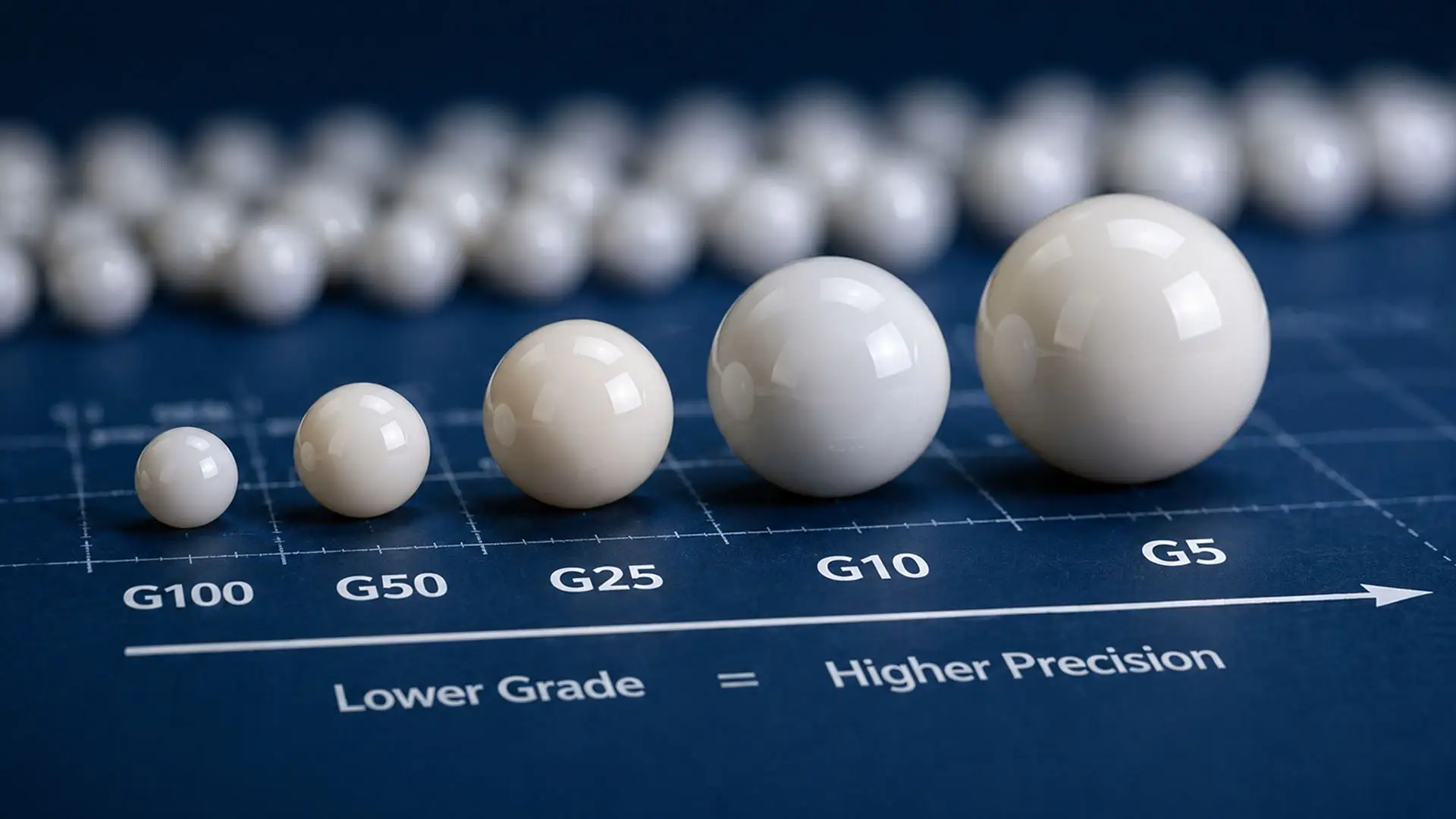
Compare Tolerance Grades for Precision Plastic Balls
Not all plastic balls are manufactured to the same level of precision. Tolerance grades define how closely each ball matches its specified diameter, as well as its roundness and surface quality. Selecting the correct grade ensures you’re not overpaying for unnecessary precision, while still meeting your application requirements.
G10 – Ultra-High Precision
Manufactured to extremely tight tolerances, G10 plastic balls offer near-perfect roundness and minimal diameter variation. Ideal for critical applications such as aerospace, medical devices and precision engineering where accuracy is non-negotiable.
G50 – Standard Industrial Precision
Designed for general-purpose use, G50 plastic balls offer dependable performance with moderate tolerance control. Suitable for less critical applications such as fluid handling, packaging systems and everyday industrial components.
G25 – High Engineering Precision
G25 provides an excellent balance between performance and cost, delivering reliable consistency for demanding mechanical systems, valve components and testing applications where high precision is required without the premium cost of G10.
Choosing the Right Grade
Selecting the correct tolerance grade ensures optimal performance while avoiding unnecessary cost. By matching precision to your application requirements, you achieve efficiency, reliability and long-term value.
Request a quote today : +44 (0) 1943 831 166
What Do G10, G25 and G50 Mean?
Tolerance grades, commonly referred to as “G grades”, are internationally recognised standards used to define the precision, consistency and quality of a plastic ball. These grades determine how closely each ball conforms to its specified diameter, as well as its roundness and surface finish.
Understanding these classifications is essential when selecting precision plastic balls, as the correct grade ensures reliable performance, repeatability and cost efficiency across a wide range of engineering and industrial applications.

Lower Grade = Higher Precision
The smaller the G number, the tighter the manufacturing tolerance, resulting in greater dimensional accuracy and consistency.

Controlled Diameter Variation
Each grade defines the allowable deviation from the nominal ball diameter, ensuring predictable sizing across batches.

Sphericity (Roundness)
Higher grades offer improved roundness, reducing irregularities that could affect movement or measurement accuracy.

Surface Finish Quality
Smoother surface finishes are achieved in tighter grades, improving performance in contact and low-friction applications.

Consistency Across Production
Tolerance grading ensures every ball performs uniformly, supporting repeatable results in high-volume manufacturing.

Application-Driven Selection
Different grades are suited to different uses, from ultra-precise engineering systems to general industrial applications.
Typical Characteristics
Understanding the differences between tolerance grades is key to selecting the right precision plastic ball for your application. The table below provides a clear comparison of G10, G25 and G50 grades, outlining how they vary in diameter accuracy, roundness (sphericity), surface finish and typical use cases. This makes it easier to match the correct level of precision to your performance requirements without over-specifying or increasing costs unnecessarily.
How to Choose the Right Tolerance Grade
Choosing the correct tolerance grade depends on your application’s performance requirements, including accuracy, consistency and operating conditions.
Accuracy Requirements
If your application requires exact measurements, tight fits or consistent repeatability, higher tolerance grades such as G10 or G25 are recommended. These grades minimise variation and ensure reliable performance in precision-critical environments.
Application Type
The demands of your application play a key role in grade selection. Dynamic systems, moving components or high-performance assemblies typically benefit from tighter tolerances to reduce friction, wear and performance inconsistencies.
Cost vs Performance
Higher precision grades come with increased manufacturing costs. It’s important to balance performance needs with budget by selecting a grade that meets your requirements without over-specifying unnecessary precision.
Material Behaviour
Different materials, such as acetal, nylon or polypropylene, respond differently to temperature, moisture and chemical exposure. Considering how the material behaves in your operating environment helps ensure long-term dimensional stability and performance.
Call us today on: +44 (0) 1943 831 166
Why Tolerance Matters in Engineering Applications
Selecting the correct tolerance grade is critical in engineering environments where precision, consistency and reliability directly impact performance. Even small variations in diameter or roundness can affect how components fit, move and function within a system, making tolerance selection a key factor in achieving dependable results.

Consistent Performance Across Batches
Tight tolerance control ensures every plastic ball performs identically, supporting repeatable results in both production environments and precision applications.

Reduced Wear and Friction
Higher precision balls offer smoother surfaces and improved roundness, reducing friction between moving parts and helping to extend component lifespan.

Improved Measurement Accuracy
In testing and inspection applications, such as bore or tube checking, accurate ball sizing ensures reliable pass-or-fail results and minimises measurement errors.

Greater Reliability in Critical Systems
Applications in sectors such as aerospace, medical or high-performance engineering rely on precise components to maintain safety, efficiency and operational stability.
Choosing an incorrect tolerance grade can result in poor fit, inconsistent performance or premature component failure, ultimately increasing costs and reducing system reliability.
How to Choose the Right Tolerance Grade
Precision plastic balls are manufactured from a range of engineering-grade materials, each offering different mechanical, thermal and chemical properties. The relationship between material choice and tolerance grade is important, as some materials are better suited to maintaining tight tolerances under specific operating conditions. Common material options include:
Acetal (POM) – High Precision and Stability
Acetal provides excellent dimensional stability, low moisture absorption and high strength, making it ideal for tight tolerance grades such as G10 and G25 in precision engineering applications.
Nylon (PA) – Strong and Versatile
Nylon offers good mechanical strength, durability and impact resistance, making it suitable for moderate precision applications where flexibility is beneficial.
Polypropylene (PP) – Chemically Resistant
Polypropylene is highly resistant to chemicals and corrosion, making it well suited to harsh environments, typically in lower precision or non-critical applications.
HDPE – Lightweight and Cost-Effective
HDPE is a lightweight, economical material that performs reliably in general-purpose applications where tight tolerances are not essential.
PTFE – Low Friction Performance
PTFE offers exceptional low friction and chemical resistance, ideal for specialised applications, although its softer nature generally suits looser tolerance grades.
Delrin® – Precision Performance
Delrin®, a high-performance acetal variant, offers superior stiffness, creep resistance and dimensional stability, making it particularly well suited to high-precision applications requiring consistent tolerances over time.
Call us today on: +44 (0) 1943 831 166
Request a Quotation or Technical Guidance
Tell us about your application, specifications and performance requirements, and our team will recommend the most suitable tolerance grade. We’ll provide clear technical guidance along with a fast, competitive quotation tailored to your needs.
